 I’ve experienced the friendship effect my entire life—probably without realizing it. Blessed with a tight circle of companions who’ve never hesitated to swoop in whenever I needed them, my friends have been there at every major turning point in my sometimes-chaotic existence.
As a lost and lonely high school freshman with a loving family but no one to hang out with, my world felt dark and empty until my friend Rosa invited me to a party where her boisterous pack of siblings made me feel welcome by laughing at everything that came out of my mouth. Suddenly, I realized I was funny. All at once, I had something to offer.
The gift Rosa handed me on that long-ago spring night gave me the confidence to be a friend to others, and the tiny knot of people in my life grew. Because I had people I could count on, my world shifted on its axis.
The friends I made in high school became the friends I took with me into adulthood. They journeyed with me through first jobs and first relationships, my struggle with coming out, marriage, making a home, and traveling the world. And when my husband died suddenly decades later, my friends Jenny and Derek invited me to rent the guest suite behind their garage so that I wouldn’t be alone. I’m convinced they not only saved my life but gave me the wherewithal to put one foot in front of the other and step into a new existence.
There’s no question that my life has been, lifted, and changed for the better by the friendships I’ve been lucky enough to build. But what I never realized is how vast and far-reaching the power of friendship can be—that its influence can alter not only our emotional lives but also bolster our physical being. I never understood the true nature of the friendship effect.
In this blog post, you’ll learn what the friendship effect is, how friendships mold our lives, the reasons why close friends are important, the different kinds of friendships we need, as well as strategies we can use to make and keep friends in our lives.
What is the friendship effect?
When most of us think of friendship, we focus on the color, depth, and fun those we depend on outside our family circle add to our lives and the emotional support they give us when the chips are down, but it turns out we need other people for more than that. The person we tell everything to, the acquaintance we gossip with at work, and even the stranger we nod to on our morning walk help support not only our emotional but also our physical health. As essential to our ability to do and be as the air we breathe and the food we eat, the people we encounter daily—whether strangers, acquaintances, or friends—are vital to our existence.
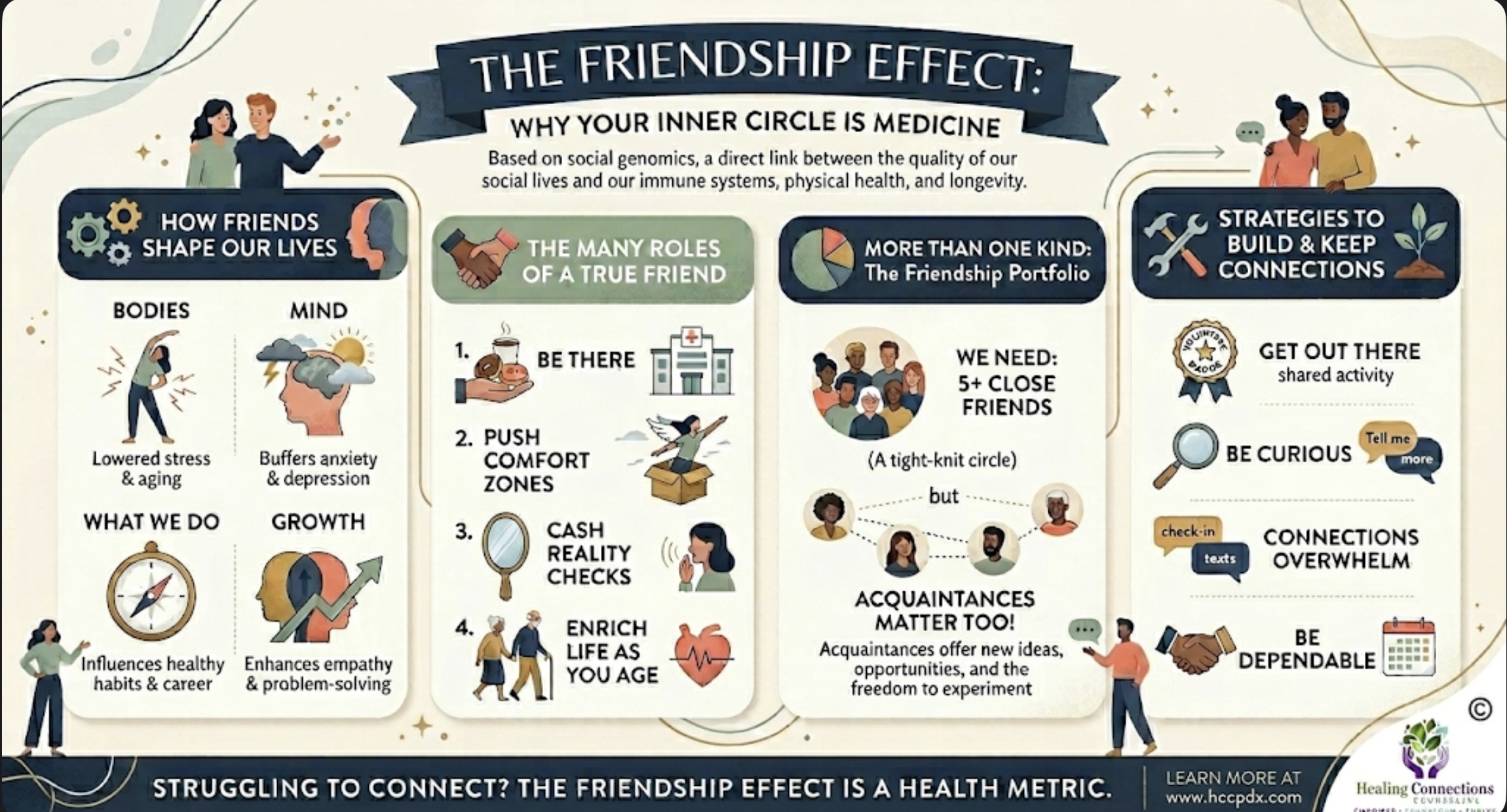
The friendship effect is based on a body of research called social genomics—research that makes a direct connection between the quality of our social lives and our immune systems. Simply put, social genomics says that a well-rounded social circle not only provides us with the emotional support we need but also makes it less likely that we’ll fall prey to illness as well.
Every exchange with another human being energizes our bodies, affecting how we feel, why we do what we do, and even how we think—enriching not only our emotional health but also the quality and quantity of our human relationships, helping us live longer, happier lives.
How Friends Shape Our Lives
In addition to improving our mental health, having our back, and helping us live longer, friends influence our lives in a myriad of other ways. Those we depend on have a profound impact on what we do, including our habits, the work we choose and even how we feel about ourselves. Here are some of the areas in which friends shape our lives:
Our Bodies: Spending time with friends not only lowers our stress levels but can actually slow down the aging process by reducing inflammation. Friends can also help us start and maintain healthy habits such as getting more exercise and eating healthier foods by supporting us in making these choices, ultimately giving us a longer shelf life.
Our Minds: Good friends buffer anxiety and depression. The fact that we know they’ll be there for us when the chips are down also spikes our self-confidence and gives our lives meaning and direction.
What We Do: The influence of friends is often so powerful that it can affect our behavior even when we don’t realize it. In addition to shaping our career path, friends can also influence our choice of significant other, spurring us on to financial prosperity as well.
How We Grow: Since we spend a lot of time together and support each other when times are tough, friends tend to mirror each other when it comes to how they picture themselves, what’s important and how they look at life. The inevitable ups and downs of friendship can also help us learn how to put ourselves in another person’s shoes and resolve our differences in a positive way.
6 Reasons Why Having Close Friends is Important
Like choosing a romantic partner who reflects positively on who we are and lifts us up rather than letting us down, choosing friends we can depend on can help us learn life’s pivotal lessons and bring joy that is vital to our emotional health. Here are some of the ways close friends make our lives richer and more vibrant. A true friend will:
- Be there for you: A true friend will surprise you with coffee and donuts on a lazy Sunday morning and show up in the emergency room when someone you love is in an accident. Real friends don’t come up with illegitimate reasons they can’t help you when you need them or discourage you when you should be encouraged most. If a friend isn’t up to the task in these areas, it may be time to move on.
- Nudge you out of your comfort zone: A godsend for those of us who tend to be shy, friends not only act as buffers in anxiety inducing events like an office party or a family wedding but can encourage us to move past our fears to explore new places and meet new people.
- Cash a reality check: Close friends are willing to risk your friendship to voice an honest opinion. Whether it’s telling you the truth about the outfit you’re wearing or letting you in on a self-sabotaging behavior, real friends can be counted on to inform you of things you may not want to hear but will give you an opportunity to grow, breaking the bad news in a way that you can hear it, gently and sincerely.
- Help you create healthy relationships: The friendships we make in child and young adulthood can give us the skills we need to become better romantic partners. The compromises we make, the disagreements we settle and the boundaries we set with friends can help us develop and use these skills with our significant other.
- Increase your “couple” skills: Instead of shutting the friend who has become part of a couple out of your life, you can use the experience as an opportunity to learn what sharing life with another person looks like.
- Enrich your life as you age: Studies show that older people who have close friends not only live longer but are less likely to fall prey to chronic disease. And even though we often depend on family members to take care of us during these years, having friends do these duties brings a different kind of happiness to those being cared for.
Why do I need more than one kind of friend?
The question of how many close friends a person needs is up for debate. While conventional wisdom says that all we need is one good friend, experts tell us that we’re more likely to live a balanced and fulfilled life if we have five close friends, with a few more or less depending on whether we’re shy or outgoing.
But whether we need one or five people we can depend on, it turns out that those we have weaker ties to are just as important—the man we stand in line behind at Starbucks every morning, the woman we see in a weekly Zoom meeting or even the stranger we nod to as we pass them on the street—all play a vital role in our living happy and productive lives.
Acquaintances are our window to new ideas, opportunities, and people we aren’t likely to run into if we stay planted firmly in the universe of close friendships. While acquaintances come with the luxury of being low maintenance, they can also introduce us to experiences we might not have if we stayed in our bubble, propelling us from our comfort zone and forcing us to examine ideas we might not agree with. And since we have less to lose with someone we might only know slightly, we’re more likely to brave new experiences, like joining that book club we’ve been thinking about but don’t feel ready to attend by ourselves.
The people we know but aren’t necessarily close to keep us from becoming stagnant. They allow us to be more our own person because we can “go it alone” in a low-risk environment and experiment with new versions of ourselves, making us more flexible, fascinating, and brave.
How do I make and keep friends?
Since having a variety of friends is not only necessary to our emotional wellbeing but can help us live healthier, longer lives, having the skills to get and keep friendships becomes even more vital. If meeting and socializing with new people doesn’t come easily, here are some strategies that may help.
Making Friends – Get Out There
You can’t make friends without working at it. Start by getting involved in an activity that means you’ll see the same people more than once and your interactions with them will be low key. For example, if you volunteer for a cause you believe in, you’re guaranteed to meet folks who have at least one interest in common and have built in conversation starters. Remember, dependability counts more than being the most fascinating person in the room.
Take It Easy
You don’t have to be smooth when it comes to starting a conversation. Ask a question that relates to what you’re both doing, like, “Is this your first class?” Another option would be to make an observation, such as, “There are a lot of people here today.” Remember, you don’t need to wow anybody, you’re just inviting the other person to tell you a little bit about who they are.
Be Curious
People respond to those they know are genuinely interested in who they are and what they have to say. This means asking follow-up questions, remembering the little things and not interrupting the other person’s train of thought. Be empathetic not impressive.
Be Brave
After you’ve gotten acquainted, it’s probably time to up the ante. Take a low-level risk by asking the other person if they’d like to join you for a cup of coffee or catch a movie the following week. If you get a no, don’t be discouraged. You can always try again or move on to someone else.
Keeping Friends – Connect but Keep It Light
You don’t need to overwhelm the other person with attention. You’re more likely to keep the friendship on track if you check in once in a while. Shoot the other person a text or a quote that reminds you of them and the time you spent together. There’s no need to have a heart-to-heart every time you connect.
Be Dependable
We’re more likely to build relationships with those we can count on. This means you do what you say you’re going to such as giving the other person a ride to the airport or showing up to a dinner party you’ve been invited to.
Converse Fairly
People who are good at making and keeping friends don’t just talk about themselves and what’s going on in their lives but take the time to find out what’s happening in the lives of others. Make your friendship a two-way street.
Be Okay with Less-Than-Perfect
Friends are just as human as you are. They’ll make mistakes and let you down, and more than likely, you’ll return the favor. This is all part of the normal give and take inevitable in any relationship.
Be the Friend You Want
Besides being consistent and dependable, take the risk of being open about what’s really happening in your life. Show the other person the empathy, honesty and care you’ve always wanted and more than likely, you’ll get it back. Be there in the bad times as well as the good, letting the other person know that you’re in the relationship for the duration.
Conclusion
True friendship is nothing short of magical, working the everyday miracle of support, inspiration, health and even longevity in our lives. But for those of us who have a hard time connecting with others, friendship can feel out of reach. Fortunately, there are ways we can bridge the gap. If we put ourselves out there, show genuine interest, be there for others, embrace the other person’s humanity and become the friend we want to have, we’re more likely to have all the friends and acquaintances we need, leaving us feeling supported, challenged, and accepted just as we are.
References
Estroff Murano, Hara, (2026, March 3). The Friend Effect. Psychologytoday.com. https://www.psychologytoday.com/us/articles/202603/the-friend-effect-23-surprising-ways-other-people-shape-you
Fuller, Kristen. M.D., (2017, October 2). Why Do We Need Friends? Six Benefits of Healthy Friendships. Psychologytoday.com. https://www.psychologytoday.com/us/blog/happiness-is-state-mind/201710/why-do-we-need-friends-six-benefits-healthy-friendships
Charles Davis is an essayist who has written for several academic publications, The Gay & Lesbian Review and The Christian Science Monitor. Mr. Davis also writes a blog on navigating loss and building a new life at: https://gayandgrieving.blog. He was a semifinalist for the 2023 Mason Jar Press 1729 Book Prize in Prose.