Most couples don’t struggle because they’ve stopped caring, they struggle because they’ve stopped connecting through their words. The conversations happen, but somehow the meaning gets lost along the way. Building strong communication skills for couples isn’t about memorizing scripts or winning arguments. It’s about creating space where both people feel genuinely heard.
At Healing Connections Counseling, we work with couples throughout Portland who want more than quick fixes. They come to us seeking real connection, the kind built on trust, vulnerability, and mutual understanding. And that connection starts with how you talk to each other in everyday moments.
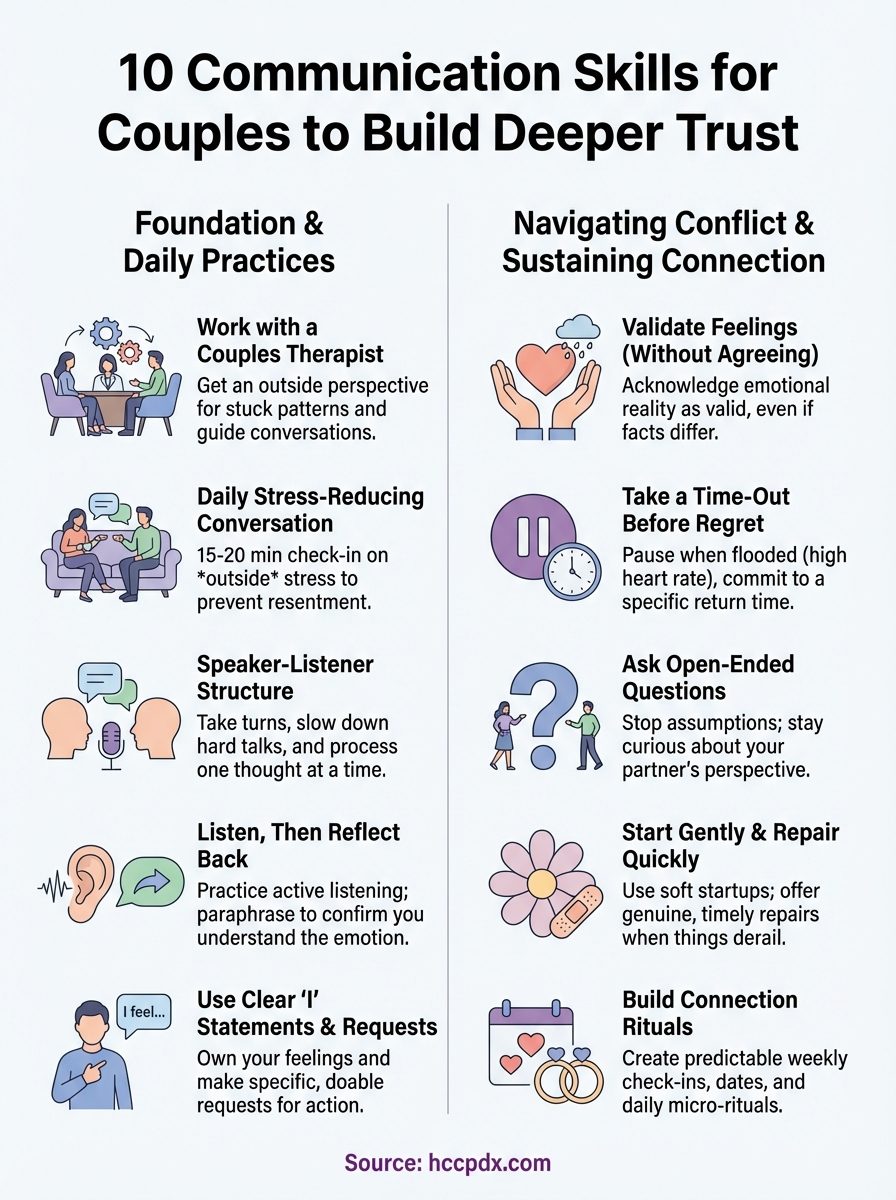
This article covers 10 practical communication skills you can begin using right away. Whether you’re working through recurring conflicts, trying to reconnect after emotional distance, or simply want to strengthen an already solid relationship, these tools offer a clear path forward. Each skill builds on the others, helping you and your partner develop deeper trust over time.
1. Work with a couples therapist when you feel stuck
Sometimes you need more than better communication skills for couples on your own. You need a professional who can see patterns you can’t, interrupt cycles before they spiral, and guide both of you toward conversations that actually build trust instead of breaking it down. Working with a couples therapist doesn’t mean your relationship is failing. It means you’re choosing to invest in something that matters before the cracks become too wide to repair.
How this support changes your communication pattern
A couples therapist brings an outside perspective that breaks the loop you’ve been stuck in. They spot the hidden triggers and protective reactions that derail your talks before you even realize what happened. Your therapist teaches you to pause, translate what you’re really feeling, and express it in ways your partner can actually receive. This shifts you from reactive patterns into intentional communication, where both people feel safer opening up.
Signs you need more than self-help tools
You know it’s time when the same fights keep returning no matter how hard you try to fix them on your own. Emotional flooding during conflicts, withdrawing for days without resolution, or feeling constantly misunderstood all signal deeper work is needed. If one or both of you have stopped trying, if you’re considering separation, or if past trauma keeps surfacing in your relationship, professional support makes the difference between stagnation and real change.
“Professional guidance helps you see what you can’t spot on your own and builds skills that last beyond the sessions.”
What to expect in couples counseling
Your first session focuses on understanding what brought you in and what you both want from therapy. The therapist will ask about your relationship history, current conflicts, and individual backgrounds. You’ll practice structured communication exercises during sessions and receive homework to apply between visits. Expect honesty, moments of discomfort, and gradual shifts in how you relate to each other rather than instant fixes.
How to choose the right therapist for your relationship
Look for someone trained specifically in couples therapy, not just individual therapy. Ask about their approach, whether it’s Gottman Method, Emotionally Focused Therapy, or another evidence-based model. You both need to feel comfortable and respected by the therapist, so schedule initial consultations with a few options. At Healing Connections Counseling in Portland, we match couples with therapists who fit their specific needs and session format preferences, ensuring the right foundation for your work together.
2. Hold a daily stress-reducing conversation
You need a space where outside stress gets processed before it seeps into your relationship. A daily stress-reducing conversation gives both of you that release valve. This practice, rooted in Gottman Method research, helps you stay emotionally connected even during overwhelming weeks. When you make this ritual non-negotiable, you prevent everyday pressures from building resentment between you.

What this skill does and why it builds trust
This conversation keeps external stressors from contaminating your bond. You share what happened in your world, your partner listens without judgment, and you both walk away feeling supported rather than alone. The act of consistent listening demonstrates that your relationship is a safe place to be vulnerable. Trust grows when your partner shows up for you every single day, not just during crises.
How to do it in 15 to 20 minutes
Set a specific time that works for both schedules, whether that’s right after work or before bed. Each person gets equal talking time to share what stressed them out that day. The listener stays fully present, puts away devices, and offers supportive responses. You take turns so both people feel heard, and you stick to the time limit to keep the practice sustainable.
What to say when your partner wants advice
Ask first: “Do you want my thoughts on this, or do you just need me to listen?” Most of the time, venting alone provides the relief your partner needs. If they do want input, offer it gently after they’ve finished talking. This question prevents you from fixing prematurely when what they really need is empathy.
“Asking permission before giving advice keeps your support from feeling like criticism.”
Boundaries that keep it from turning into a fight
Focus only on outside stressors, not complaints about each other. If relationship issues surface, acknowledge them and schedule a separate time to discuss. Keep your tone neutral and avoid blame language about how your partner contributed to your bad day. This conversation strengthens communication skills for couples by creating a container where support flows freely without triggering defensiveness.
3. Use the speaker-listener structure for hard talks
When emotions run high and you need to discuss something that matters, an unstructured conversation often spirals into accusations and shutdowns. The speaker-listener technique creates clear roles that prevent both people from talking over each other or mentally preparing rebuttals while the other person is still speaking. This structured approach slows down the pace enough for your brain to process information without triggering your fight-or-flight response.
What the structure is and why it works
One person holds the speaker role and shares their perspective without interruption. The other takes the listener role and focuses entirely on understanding, not responding or defending. You switch roles only after the listener accurately reflects back what they heard. This removes the chaos of simultaneous talking and creates space for genuine understanding before either person reacts.
Step-by-step flow to keep both people regulated
The speaker shares one thought or feeling at a time, keeping statements brief. The listener paraphrases what they heard without adding interpretation or counterarguments. The speaker confirms whether the listener got it right or clarifies if needed. Once understanding is confirmed, you switch roles so the other person can share their perspective using the same process.
“Taking turns as speaker and listener keeps both people regulated when the topic matters most.”
Phrases that keep you out of blame and defensiveness
The speaker uses phrases like “I felt hurt when…” or “I’m worried about…” instead of “You always…” or “You never…” The listener responds with “What I’m hearing is…” or “It sounds like you’re feeling…” These communication skills for couples replace reactive language with reflective statements that lower tension.
How to practice on low-stakes topics first
Start with neutral subjects like planning weekend activities or discussing a movie you both watched. This builds muscle memory for the structure before you tackle emotionally charged issues. Practice until the back-and-forth feels natural, then apply it to bigger conflicts when you both feel ready.
4. Listen to understand, then reflect back the message
Most people listen with half their attention while planning what they’ll say next. Real listening means you set aside your own response, your defenses, and your need to be right long enough to truly absorb what your partner is saying. When you reflect their message back to them, you prove you heard more than just words. You understood the feeling underneath. This practice transforms communication from a debate into a dialogue.
What active listening looks like in real life
You maintain eye contact and put your phone face down. Your body turns toward your partner rather than angling away. You notice their tone and body language, not just their words. Active listening means you pause before responding, taking a breath to let their message land fully before you react.
How to paraphrase without sounding robotic
Use your own words to capture the core emotion and main point. Instead of repeating verbatim, say “It sounds like you felt dismissed when I didn’t respond to your text” rather than mechanically echoing “So you’re saying you felt dismissed.” Natural paraphrasing shows you processed the meaning, not just memorized their sentences.
“Paraphrasing in your own words proves you understood the emotion, not just the facts.”
Questions that confirm you got it right
Ask “Did I get that right?” or “Is there more you want me to understand about this?” These clarifying questions give your partner a chance to correct misunderstandings before they spiral. Simple check-ins prevent you from building arguments against things your partner never actually said.
Listening habits that silently break trust
Interrupting mid-sentence signals their words don’t matter. Checking your phone while they talk sends the same message. Bringing up past conflicts or shifting focus to your own story before they finish breaks the trust that genuine listening builds. These communication skills for couples only work when your attention stays fully present.
5. Speak with clear I statements and specific requests
Your words either open doors or slam them shut. When you lead with accusations or vague complaints, your partner’s brain registers threat and shuts down before you finish your sentence. I statements paired with specific requests give both of you a fighting chance at productive conversation. These communication skills for couples shift the focus from blame to solution, from criticism to collaboration.
How I statements lower defensiveness
Starting with “I feel” or “I need” keeps your partner’s nervous system from activating defense mode. You own your experience rather than attacking their character. “I felt alone when you didn’t text back” lands softer than “You ignored me all day.” This small language shift prevents your partner from mentally building walls while you’re still talking.
How to turn a complaint into a doable request
Replace “You never help around here” with “I feel overwhelmed by the dishes piling up. Would you handle them tonight?” Every complaint hides a specific need. Your job is to extract that need and voice it as a clear action your partner can actually take. Doable requests create forward motion instead of circular arguments.
“Turning complaints into specific requests gives your partner something concrete to act on rather than defend against.”
Script examples for common couple conflicts
Try “I feel disconnected when we don’t talk during dinner. Can we put phones away for 20 minutes?” instead of “You’re always on your phone.” Or say “I need reassurance when I’m anxious. Could you tell me we’re okay?” rather than “You don’t care about my feelings.”
What to do when your partner hears it as criticism anyway
Pause and ask “What did you hear me say?” Their answer reveals where the message got twisted. Clarify your intention and restate your request more simply. Sometimes you need to repair before you can move forward.
6. Validate feelings without agreeing on the facts
You can acknowledge your partner’s emotional experience without signing off on their version of events. Validation means you recognize and respect their feelings as real and legitimate, even when your memory or interpretation differs completely. This is one of the most powerful communication skills for couples because it separates emotional truth from factual debate. Your partner needs to feel heard before they can hear you.

What validation is and what it is not
Validation acknowledges the emotional reality your partner is experiencing right now. You’re not endorsing their interpretation of what happened or admitting fault. Saying “I can see you’re really hurt” doesn’t mean you agree you caused that hurt intentionally. Non-validation looks like dismissing their feelings with phrases like “You’re overreacting” or “That doesn’t make sense.” These responses shut down connection instantly.
Validation phrases that calm the conversation fast
Try “That sounds really frustrating” or “I can understand why you’d feel that way given what you experienced.” Use “It makes sense you’re upset” even when their logical reasoning doesn’t match yours. These phrases lower your partner’s emotional temperature by confirming their internal experience matters to you.
“Validating feelings first creates the safety needed for productive problem-solving later.”
How to respond when you feel misunderstood
State “I want to understand your feelings, and I also see this differently. Can we hold both?” This bridges the gap between validation and your own truth. You validate their emotion while maintaining space for your perspective without canceling out theirs.
How validation strengthens emotional safety over time
Consistent validation builds psychological safety where both people risk vulnerability without fear of dismissal. Your partner learns their feelings won’t be weaponized or minimized. This foundation allows deeper conversations about difficult topics because trust accumulates through repeated experiences of being emotionally received.
7. Take a time-out before you say something you regret
Your brain can’t think clearly when you’re emotionally flooded. Blood rushes away from your prefrontal cortex, the part that helps you reason and regulate, straight into your fight-or-flight system. Words that come out during this state damage trust in ways that apologies can’t fully undo. Taking a strategic time-out before you cross that line is one of the most protective communication skills for couples you can develop.
Early signs you need a pause
Your body tells you before your words do. Notice when your heart rate spikes, your chest tightens, or your thoughts start racing toward the worst interpretation of everything your partner says. You might feel heat rising in your face or notice yourself clenching your jaw. These physical cues signal your nervous system has shifted into defense mode and productive conversation is no longer possible.
How to call a time-out and commit to returning
Say “I need a break. Can we come back to this in 30 minutes?” The specific time frame matters because it prevents your partner from feeling abandoned mid-conflict. Avoid vague statements like “I can’t do this right now” that leave them hanging. You both agree to the pause and to the return time, creating structure that builds trust rather than eroding it.
“Setting a specific return time prevents the break from feeling like abandonment or avoidance.”
What to do during the break so it helps
Walk outside, do jumping jacks, or practice deep breathing until your heart rate drops below 100 beats per minute. Avoid replaying the argument or building your defense case, which keeps your nervous system activated. The goal is physiological calming, not mental rehearsal for round two.
How to restart the talk without reopening the whole fight
Begin with “I’m calmer now and want to understand your perspective” rather than jumping back into your original point. Acknowledge the emotional intensity that required the break. This reset allows both people to approach the conversation with regulation restored and defenses lowered.
8. Ask open-ended questions and stop mind-reading
You think you know what your partner meant, why they did what they did, or what they’re feeling right now. But assumptions replace actual understanding with stories your brain creates to fill gaps. These mental shortcuts feel efficient until they trigger fights over things your partner never actually thought or intended. Asking open-ended questions and checking your interpretations keeps you connected to reality instead of the narratives running through your head. This shift is essential among communication skills for couples because curiosity prevents conflict before it starts.
How assumptions create conflict loops
Your brain makes up explanations when information feels incomplete. You assume your partner’s silence means anger when they’re actually processing information. You interpret their tone as criticism when they’re simply tired. These mental stories become facts in your mind, and you react to your version of events rather than asking what’s actually happening. Each unchecked assumption adds another layer to the conflict until you’re arguing about things that never occurred.
Open-ended question starters that open people up
Replace “Why did you do that?” with “What was going through your mind when that happened?” Use “Help me understand…” or “What do you need from me right now?” instead of closed questions that trigger yes-or-no answers. Curiosity-driven questions invite your partner to share their internal experience rather than defend their actions.
“Open-ended questions invite your partner into conversation rather than putting them on trial.”
How to stay curious when you feel hurt
Pause before you accuse. Ask “Did you mean it that way?” or “Can you tell me more about what you intended?” Your hurt is real, but your interpretation of their intention might be wrong. Staying curious when you’re activated takes practice, but it prevents you from damaging the relationship over misunderstandings.
What to do when your partner shuts down or goes quiet
Give them space without making up stories about why they withdrew. Say “I notice you got quiet. Do you need time, or is there something I can do?” This gentle inquiry respects their process while keeping the door open for connection when they’re ready.
9. Start gently and repair quickly when things go sideways
The first three minutes of a difficult conversation predict how the entire exchange will unfold. Research from the Gottman Institute shows that harsh startups lead to harsh endings almost every time. When you launch into conflict with criticism or contempt, your partner’s defenses activate before you finish your opening sentence. Learning to start softly and repair fast when things derail are essential communication skills for couples that prevent minor disagreements from becoming relationship-defining fights.

What a gentle start sounds like
You begin with your own feelings rather than attacking your partner’s character. Soft startups use phrases like “I’m feeling overwhelmed and need help figuring this out” instead of “You never think about anyone but yourself.” Your tone stays calm and respectful even when the topic matters deeply. This approach keeps your partner’s nervous system regulated enough to actually hear what you’re saying.
Repair attempts that actually land
Repairs work when they’re timely and genuine. Say “Wait, that came out wrong” or “Can we start over?” the moment you notice the conversation spiraling. Humor can work if it’s not sarcastic. Touch your partner’s hand, take responsibility for your part, or simply pause to breathe together. The faster you repair, the less damage accumulates.
“Quick repairs prevent small missteps from becoming lasting wounds in your relationship.”
How to apologize without adding a but
Stop your apology after “I’m sorry.” The word “but” erases everything that came before it. Authentic apologies own your impact without justifying your intention or shifting blame back to your partner. “I’m sorry I snapped at you” stands on its own without “but I was stressed” attached to the end.
How to rebuild after recurring blowups
Address the pattern directly rather than pretending each fight exists in isolation. Discuss what triggers your escalation cycle during calm moments, not mid-conflict. Create a shared plan for catching yourselves earlier next time and commit to practicing gentler starts together.
10. Build connection rituals that protect your communication
Your relationship needs structured connection points that happen whether you feel like it or not. These rituals create predictable moments where you check in, appreciate each other, and address small issues before they grow into resentment. Unlike spontaneous connection, which depends on mood and circumstance, intentional rituals protect your bond during busy seasons and stressful periods. They’re the infrastructure that keeps your communication skills for couples sharp even when life pulls you in different directions.
Weekly check-ins that prevent resentment
Schedule a standing meeting every week where you discuss what’s working, what needs attention, and upcoming logistics. This prevents small irritations from accumulating into explosive fights. You address the minor friction points while they’re still manageable rather than waiting until someone reaches their breaking point.
How to use the 2-2-2 rule and the 7-7-7 rule
The 2-2-2 rule means date night every two weeks, a weekend away every two months, and a week-long trip every two years. The 7-7-7 rule suggests daily seven-second kisses, weekly seven-minute meaningful conversations, and monthly seven-hour dates. These frameworks create consistent touchpoints that maintain emotional and physical intimacy regardless of how hectic your schedules become.
“Regular connection rituals prevent your relationship from running on autopilot until something breaks.”
Micro-rituals that keep you on the same team
Create daily routines like six-second hugs when you reunite after work or three things you appreciate before bed. These small moments accumulate into emotional security over time. They remind both of you that you’re partners, not adversaries managing a household together.
How gratitude changes the tone of everyday talk
Expressing specific appreciation daily shifts your brain’s focus from what’s wrong to what’s working. Say “I noticed you unloaded the dishwasher without being asked” instead of generic thank-yous. This practice rewires how you perceive your partner’s actions and makes positive communication your default mode.
Next steps you can take this week
Pick one or two of these communication skills for couples and practice them daily rather than trying to implement all ten at once. Start with the daily stress-reducing conversation or the speaker-listener technique during your next challenging discussion. These skills build on each other, so mastering the basics creates momentum for everything else. Consistency matters more than perfection when you’re rewiring how you talk to each other.
If you’ve tried these tools and still find yourselves stuck in the same patterns, professional support accelerates progress in ways self-help alone can’t match. Working with someone who understands relationship dynamics helps you spot the blind spots keeping you trapped and gives you personalized strategies that fit your specific situation.
Schedule a consultation at Healing Connections Counseling to connect with a therapist who specializes in couples work throughout Portland. Both virtual and in-person sessions are available, and we’ll match you with a provider who fits your needs and communication goals.