
Betrayal cuts deep. Whether it’s infidelity, broken promises, or discovering a partner has been dishonest, the aftermath leaves you questioning everything you thought you knew about your relationship. Learning how to rebuild trust after betrayal isn’t just about moving past what happened, it’s about deciding whether the relationship can be repaired and, if so, creating a new foundation together.
If you’re reading this, you’re likely caught between hope and heartbreak. You want answers. You want to know if healing is possible, what it actually takes, and whether the pain you’re carrying will ever ease. These are the questions our therapists at Healing Connections Counseling hear often from couples navigating this exact crossroads in Portland and throughout Oregon. The path forward isn’t linear, and it looks different for every relationship, but it does exist.
This guide walks you through the essential steps for rebuilding trust after betrayal, from understanding the emotional impact to establishing new patterns of communication and accountability. Whether you’re the one who was hurt or the one who caused the harm, you’ll find practical guidance grounded in what actually works in therapy and real relationships.
What trust needs after betrayal
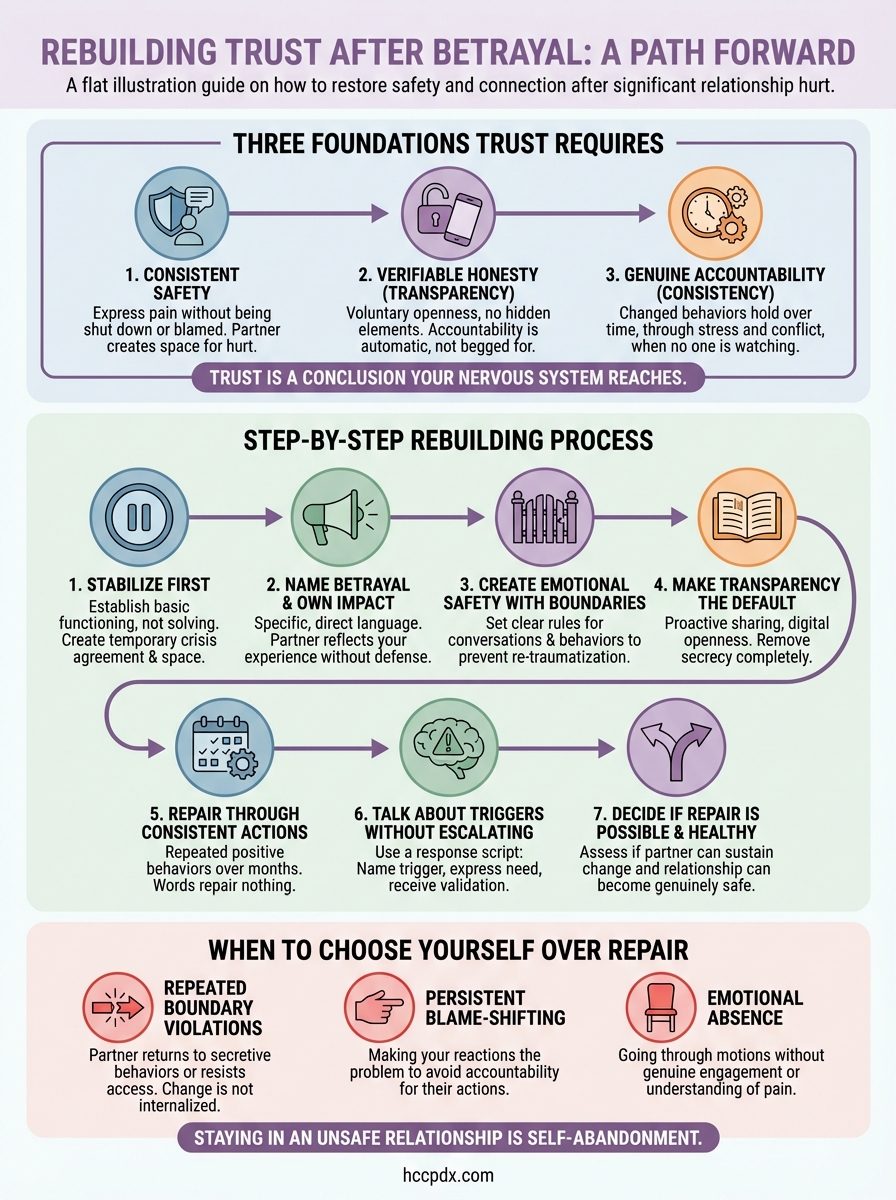
Trust doesn’t come back because you want it to or because enough time has passed. After betrayal, trust requires three specific conditions that most people skip: consistent safety, verifiable honesty, and genuine accountability. Without these foundations, you’re building on sand, and every conversation about the betrayal will feel like starting from scratch.
Understanding how to rebuild trust after betrayal starts with recognizing that trust isn’t a feeling you create through reassurance or promises. Trust is a conclusion your nervous system reaches after witnessing repeated proof that you’re safe with this person. Your partner can say “I’ll never do it again” a hundred times, but your body keeps score, and it needs evidence, not just words.
Trust rebuilds through pattern recognition, not through single acts of sincerity.
Three foundations trust requires
Safety means you can express hurt, anger, or doubt without being shut down, blamed, or punished for it. The person who caused the betrayal needs to create space for your pain without making themselves the victim. If every conversation about what happened turns into defending themselves or asking you to move on faster, safety doesn’t exist yet.
Transparency replaces the secrecy that enabled the betrayal. This isn’t about surveillance or control. It’s about the person who broke trust voluntarily opening their life in ways that used to be hidden. Phone passwords become shared. Plans get communicated clearly. Accountability becomes automatic, not something you have to beg for.
Consistency proves that change is real, not performative. Anyone can be kind for a week or honest for a month when they’re scared of losing you. Trust starts returning when you see the same behaviors hold across months, through stress, through conflict, and when no one is watching.
Why repair takes longer than you expect
Most couples underestimate the timeline for healing. You’re not just recovering from one event. You’re rewiring neural pathways that linked this person to safety, and that rewiring doesn’t happen on a schedule. Your brain created shortcuts that said “this person is safe” and betrayal broke those shortcuts. Rebuilding them requires your nervous system to gather new data points repeatedly.
The person who caused the harm often wants the hurt partner to “get over it” faster than is realistic. They’re tired of being in the doghouse. They’ve apologized. They’ve changed their behavior. But healing doesn’t speed up because someone is impatient with the process. Pressure to forgive faster actually slows repair because it signals that your pain is inconvenient, which recreates the original dynamic that allowed betrayal to happen.
The difference between forgiveness and repair
Forgiveness is personal. You can forgive someone and still decide the relationship isn’t safe to continue. Forgiveness releases you from bitterness and obsessive replaying of what happened. It’s something you do for your own peace and closure, regardless of whether the relationship survives.
Repair is relational. It requires both people actively participating in creating something new. You can’t repair trust alone, and the person who caused the betrayal can’t repair it through effort alone either. Repair happens in the space between you, through thousands of micro-interactions that slowly rebuild confidence in each other.
Step 1. Stabilize before you try to solve it
The immediate aftermath of discovering betrayal is crisis mode. Your nervous system is flooded, sleep becomes impossible, and every conversation escalates into accusations or defensiveness. Before you can work on how to rebuild trust after betrayal, you need to stop the bleeding. This means creating enough emotional stability that both of you can think clearly instead of just reacting.
Stabilization isn’t about fixing anything yet. It’s about establishing basic functioning so you can make decisions from a grounded place rather than from panic or rage. Most couples skip this step and jump straight into processing what happened, which turns every conversation into a fight because neither person has the capacity to handle the emotional weight productively.
What stabilization actually means
Stabilization creates temporary structure when everything feels chaotic. You’re not making permanent decisions about the relationship. You’re agreeing to basic conditions that let both people catch their breath and assess what happens next. This might mean sleeping in separate rooms for a week, agreeing not to discuss the betrayal after 9 PM, or scheduling one specific time daily to talk about it instead of bringing it up constantly.
Physical safety comes first. If you’re the hurt partner and you can’t be in the same space without feeling overwhelmed, you take that space. If you’re the person who caused the betrayal and your partner needs you to stay with a friend for a few days, you respect that boundary. Creating distance isn’t giving up. It’s creating room to regulate your nervous system.
Stability precedes understanding, and understanding precedes repair.
Create a temporary crisis agreement
Sit down together when you’re both calm and outline basic agreements that help you function in the immediate crisis. These aren’t forever rules. They’re stabilization tools that expire after an agreed timeframe, typically one to three weeks.
Example crisis agreement:
- Check-ins: We’ll talk about the betrayal between 7-8 PM only, not at bedtime or first thing in the morning.
- Space: Either person can take a 30-minute break from a conversation if they’re escalating.
- Transparency: Full access to phones, social media, and schedules with no pushback.
- Support: We each identify one person outside the relationship we can talk to when overwhelmed.
- Review date: We reassess this agreement on [specific date] to decide next steps.
Write this down. Make it visible. When emotions run high, having a written agreement prevents arguments about what you decided when you were thinking more clearly.
Step 2. Name the betrayal and own the impact
Once you’ve stabilized enough to have productive conversations, the person who caused the betrayal needs to name exactly what they did and acknowledge the full weight of how it affected you. This isn’t about forcing an apology script. It’s about the person who broke trust demonstrating that they understand what they actually did and why it shattered your sense of safety. Vague acknowledgments like “I’m sorry I hurt you” don’t cut it because they avoid the specific actions that caused harm.
Many people who caused betrayal want to skip past this step because sitting with the damage they created feels unbearable. They minimize, deflect, or turn the conversation toward their own pain. But you can’t learn how to rebuild trust after betrayal if the person responsible won’t clearly state what happened and take full ownership of the impact without excuses.
Naming what happened without softening it is the foundation for everything that follows.
How to name what happened without softening it
Specific language replaces euphemisms. Instead of “I made a mistake,” the person who caused betrayal says “I had an affair with my coworker for six months and lied to you repeatedly about where I was.” Instead of “things got out of hand,” they say “I chose to hide this financial decision from you, which violated the agreement we made about shared finances.”
Directness matters because your brain needs to hear that this person sees reality the same way you do. When someone softens their language or talks around what they did, your nervous system reads it as continued dishonesty, which makes repair impossible.
What owning impact looks like in practice
The person who caused betrayal needs to reflect back your experience without defending themselves. This means saying things like:
Ownership statement template:
“What I did was [specific action]. I understand this made you feel [specific emotion] because [specific reason]. I see how my choice to [action] damaged your ability to [specific trust element]. This isn’t your fault. I chose this, and I’m responsible for the pain it caused.”
Example: “I had an ongoing emotional affair and deleted messages to hide it. I understand this made you feel crazy because you noticed something was wrong but I kept denying it. I see how my lying destroyed your ability to trust your own perceptions. This isn’t your fault. I chose deception, and I’m responsible for shattering your sense of what was real in our relationship.”
Actions replace defensiveness. Owning impact means stopping yourself mid-sentence when you feel the urge to explain why you did it or point out what your partner did that contributed. Those conversations might happen later, but not during the step where you’re naming and owning what you did.
Step 3. Create emotional safety with clear boundaries
Emotional safety after betrayal doesn’t happen through reassurance alone. It requires clear boundaries that protect both people from re-traumatizing conversations and establish what behavior is acceptable going forward. Without boundaries, every discussion about the betrayal turns into an unpredictable battle, and the hurt partner stays in constant fight-or-flight mode. Learning how to rebuild trust after betrayal means creating structure around how you engage with the pain so both people can participate without shutting down or exploding.
Boundaries aren’t punishment or control. They’re agreements about engagement that help you navigate the hardest conversations without causing additional damage. The person who caused the betrayal often resists boundaries because they feel like restrictions, but actually boundaries create the container for healing that makes repair possible. Your relationship needs defined edges right now because the old patterns failed.
Set boundaries around repair conversations
Time boundaries prevent exhaustion and circular arguments. You decide together when you’ll discuss the betrayal and when those conversations end. Example: “We talk about what happened between 7-8 PM on Tuesdays and Thursdays. Outside those times, unless there’s an emergency, we focus on daily functioning.”
Process boundaries establish how you communicate during difficult moments. If you’re the hurt partner, you might set a boundary like “I need you to listen without interrupting for five minutes before you respond” or “When I bring up a trigger, I need you to acknowledge it instead of defending yourself immediately.”
Boundaries create the predictability that shattered trust needs to begin forming again.
What healthy boundaries look like in practice
Clear boundaries name specific behaviors and their consequences. Vague statements like “you need to be more honest” don’t work because they’re not measurable. Specific boundaries create accountability and mutual understanding about what happens if boundaries get violated.

Boundary template:
- The boundary: [Specific action or limit]
- Why it matters: [How this protects safety or healing]
- What happens if violated: [Agreed consequence]
Example boundaries after betrayal:
- The boundary: No contact with the affair partner under any circumstances.
- Why it matters: Contact prevents healing and maintains secrecy.
- What happens if violated: Separation while we reassess if repair is possible.
Additional example: “No dismissive language when I express hurt. If you say things like ‘you’re overreacting’ or ‘I already apologized,’ I will end the conversation and we’ll try again later when you can stay present with my experience.”
Boundaries shift as healing progresses, but early boundaries after betrayal need to be protective and specific, giving your nervous system proof that this relationship now operates differently than it did when betrayal was possible.
Step 4. Make transparency your default setting
Transparency after betrayal means voluntarily sharing information before you’re asked for it. The person who broke trust needs to open their life in ways that used to be private or hidden, not because you’re policing them, but because they’re demonstrating that secrecy no longer exists between you. This isn’t about control or surveillance. It’s about the person who caused harm proving through consistent openness that they’ve eliminated the conditions that made betrayal possible. When you understand how to rebuild trust after betrayal, you realize transparency isn’t optional in the early stages of repair.
Your partner doesn’t get to decide when they’ve been transparent enough. Your nervous system decides that, and it needs months of consistent openness before it starts to relax. The person who caused betrayal often resists this level of openness because it feels invasive or uncomfortable, but that discomfort is exactly the point. Transparency should feel vulnerable because betrayal happened in the shadows.
Transparency isn’t about proving innocence. It’s about making hiding impossible.
What transparency actually requires
Proactive sharing replaces defensive withholding. Your partner tells you where they’re going before they leave, shares their phone without hesitation when you ask, and volunteers information about interactions that might trigger concern. Example: “I ran into [person] at the store today. We talked for two minutes about work stuff. I’m telling you because I know you need to hear about these interactions.”
Digital openness means shared passwords, location sharing turned on, and no deleted messages or hidden apps. This isn’t forever, but in the months after betrayal, your partner needs to eliminate digital secrecy completely. If they resist this level of access, they’re prioritizing comfort over your healing, which signals they’re not ready for the work repair requires.
Create transparency agreements that work
Written agreements about transparency prevent arguments about what was promised. You both need crystal clear expectations about what information gets shared and when.
Transparency agreement template:
- Daily check-ins: Share schedule changes or unexpected interactions immediately, not later.
- Phone access: Full access to phone, email, and social media without warning or preparation time.
- Location sharing: GPS location stays on and accessible through [specific app].
- Social boundaries: No private messaging with [specific people or categories]. All conversations stay visible.
- Financial transparency: All accounts accessible. No hidden purchases or separate accounts.
Document these agreements together. Review them monthly to adjust as healing progresses, but in early repair stages, transparency needs to be complete and non-negotiable. Your partner proves their commitment through consistent voluntary disclosure, not through resistance or resentment about boundaries.
Step 5. Repair trust through consistent actions
Words repair nothing. Actions rebuild trust, but only when they repeat consistently across months without prompting or supervision. The person who caused betrayal needs to demonstrate that their changed behavior isn’t performance for your benefit. It’s their new baseline. When you’re learning how to rebuild trust after betrayal, you realize that trust returns through pattern recognition, not through promises or occasional good behavior. Your nervous system watches for proof that this person operates differently now, and it needs to see the same reliable actions hundreds of times before it stops waiting for the other shoe to drop.
Single acts of accountability mean little. Anyone can be transparent for a week or responsive for a month when they’re scared of losing you. Trust starts forming when you see your partner maintain boundaries they set for themselves, volunteer information without being asked, and stay emotionally present during difficult conversations across three months, six months, then longer. The timeline varies, but the principle doesn’t change: consistency proves commitment in ways words never can.
Actions that cost nothing to maintain reveal whether change is genuine or temporary.
What consistent actions demonstrate
Daily follow-through on transparency agreements shows that your partner has internalized the changes rather than performing them. They share their schedule without prompting. They hand you their phone before you ask. They check in proactively when plans shift or they run late. These micro-behaviors become automatic, not something they remember to do because you’re watching.
Emotional consistency matters as much as behavioral consistency. Your partner stays engaged when you express hurt or bring up the betrayal instead of shutting down or getting defensive. They absorb your pain without making themselves the victim across multiple conversations, which proves they can handle the weight of what they caused.
Track patterns, not incidents
Pattern tracking helps you assess whether consistency is real. Create a simple log where you note whether agreed behaviors happened without prompting:
Consistency tracking framework:
- Week 1-4: Track daily whether transparency agreements were followed voluntarily
- Month 2-3: Note emotional responses during difficult conversations (stayed present vs. defensive)
- Month 4-6: Document whether behaviors held during stress or conflict
- Review pattern: Are behaviors becoming automatic or do they require constant reminding?
If you’re constantly reminding your partner of boundaries or they only maintain transparency when you’re checking, consistency isn’t happening yet. Real change shows up when your partner maintains agreements even when you’re not monitoring, which signals they’ve committed to being a different person, not just avoiding consequences.
Step 6. Talk about triggers without escalating
Triggers after betrayal are neurological landmines that explode without warning. A text notification, a location your partner visits, or even a specific time of day can send you spiraling back into the initial pain of discovery. Learning how to rebuild trust after betrayal requires both partners to understand that triggers aren’t manipulation or unreasonable sensitivity. They’re your nervous system’s alarm signaling that it detected something it associates with danger. The goal isn’t to eliminate triggers immediately. It’s to create a process for talking about them that doesn’t turn every trigger into a fight.
Most couples escalate when discussing triggers because neither person knows how to navigate the conversation productively. The hurt partner feels ambushed by their own emotional reaction and expresses it as accusation. The person who caused betrayal feels attacked and becomes defensive instead of curious. Both people end up further apart instead of working together to address what’s happening.
Triggers are information about what your nervous system still needs to heal, not evidence of your partner’s current behavior.
Recognize your triggers before they overwhelm you
Physical awareness gives you early warning before a trigger completely hijacks your thinking. You might notice your chest tightening, your breathing getting shallow, or a sudden wave of nausea when something reminds you of the betrayal. These body signals appear seconds before the emotional flood, giving you a brief window to name what’s happening instead of reacting from it.
Identify your specific triggers by tracking what situations, places, or interactions consistently spark intense reactions. Common triggers include your partner being late without explanation, seeing them on their phone when you enter the room, or certain songs or locations connected to when the betrayal occurred. Write down your triggers so you can communicate them clearly when you’re calm rather than discovering them mid-crisis.
Create a trigger response script
Having a prepared framework for discussing triggers prevents improvisation during emotional flooding. You need specific language that helps you express what’s happening without attacking your partner and helps your partner respond supportively instead of defensively.

Trigger conversation template:
“I’m triggered right now. When [specific situation], I felt [physical sensation] and my mind went to [specific fear connected to betrayal]. I need [specific support] from you. Can you do that?”
Example: “I’m triggered right now. When you didn’t text me you’d be late, I felt my chest tighten and my mind went to all the times you lied about where you were. I need you to acknowledge this makes sense given what happened and reassure me about where you actually were. Can you do that?”
Your partner’s response matters as much as your ability to name the trigger. They need to validate your experience before explaining circumstances: “That makes complete sense given what I did. You’re not overreacting. I was stuck in a meeting and should have texted. I’m at the office and here’s proof if you need it.”
Step 7. Decide if repair is possible and healthy
Not every relationship should survive betrayal. Some betrayals reveal fundamental incompatibilities or patterns of harm that make repair impossible, and staying becomes more damaging than leaving. Understanding how to rebuild trust after betrayal includes knowing when to stop trying. This decision point typically comes after you’ve given genuine effort to the repair process for several months and have enough data to assess whether your partner is capable of sustained change or if you’re watching the same patterns repeat with different packaging.
The question isn’t whether you still love them or whether they’re trying harder now. The question is whether this relationship can become genuinely safe for you and whether the person who caused betrayal has demonstrated they’re capable of maintaining the changes trust requires. Some people aren’t, and no amount of your effort changes that reality.
Staying in a relationship that cannot become safe is not commitment. It’s self-abandonment.
Signs repair isn’t working
Repeated boundary violations signal that your partner hasn’t internalized the changes they need to make. They might follow transparency agreements for a few weeks, then gradually return to secretive behaviors. They resist when you ask for phone access or get defensive when you express hurt instead of staying present with your pain.
Blame-shifting persists across months of attempted repair. Your partner continues making your reactions the problem instead of addressing what they did. They say things like “I can’t do anything right” or “you’re never going to forgive me” to avoid accountability rather than sitting with the discomfort their actions caused.
Emotional absence shows up when your partner goes through motions without genuine engagement. They attend therapy because you demanded it, not because they want to understand themselves. They apologize because it’s expected, not because they’ve grasped the full weight of what they destroyed.
When to choose yourself over the relationship
Your physical health deteriorating signals your body telling you this environment isn’t sustainable. Chronic insomnia, digestive issues, or panic attacks that persist beyond the initial crisis phase indicate your nervous system can’t regulate in this relationship, regardless of apparent improvements in your partner’s behavior.
Use this decision framework when you’re stuck:
Repair assessment questions:
- Has my partner maintained changed behavior for at least 6 months without constant reminding?
- Do I feel progressively safer or am I still in constant surveillance mode?
- Can I imagine trusting this person again or does that feel impossible?
- Am I staying because I believe repair is happening or because I’m afraid to leave?
If honest answers reveal you’re choosing to stay out of fear rather than evidence of real change, that’s information worth respecting.
Where to go from here
Knowing how to rebuild trust after betrayal gives you a framework, but implementing these steps requires sustained effort that most couples find extremely difficult without professional support. You’re dealing with complex emotional wounds that need specialized guidance to heal properly and determine if repair is genuinely possible. The therapists at Healing Connections Counseling in Portland work specifically with couples navigating the aftermath of betrayal, helping you assess whether your relationship can become safe again and guiding you through the actual process of rebuilding connection together.
Whether you’re months into attempted repair or just discovered the betrayal, you don’t have to figure this out alone. Individual therapy helps you process your own pain and confusion while couples work gives both partners the structure and accountability that genuine repair requires. Professional support accelerates healing that might otherwise take years or stall completely without intervention. Connect with a therapist who understands rebuilding trust and can help you decide your next steps with clarity instead of drowning in confusion and pain.