You care about your relationship. You want it to work. But somewhere along the way, saying “yes” became automatic, even when you meant “no.” Learning how to set boundaries in a relationship isn’t about building walls or pushing your partner away. It’s about creating the space you need to show up fully for yourself and the people you love.
Without clear limits, resentment builds quietly. You might feel drained, unheard, or like you’re slowly losing yourself. Healthy boundaries protect your emotional well-being while strengthening, not weakening, your connection with others. The good news? Boundary-setting is a skill, and skills can be learned.
This guide walks you through practical steps for establishing and maintaining boundaries with your partner. At Healing Connections Counseling, we work with adults and couples in Portland who face these exact challenges every day, people who want deeper connection but struggle to voice their needs. Whether you’re nervous about your partner’s reaction or unsure where to even start, you’ll find concrete tools here to build a relationship grounded in mutual respect and authentic communication.
What healthy boundaries are and why they matter
Boundaries are the limits you set to protect your time, energy, and emotional well-being in any relationship. They define where you end and your partner begins. When you establish a boundary, you’re saying, “This is what I need to feel safe and respected.” These limits aren’t about controlling your partner’s behavior; they’re about clarifying what you will and won’t accept in how others treat you.
You might wonder if setting boundaries makes you selfish or demanding. The opposite is true. Boundaries create the foundation for genuine intimacy because they allow both people to show up authentically without fear of losing themselves. Without them, you risk becoming a version of yourself that bends, accommodates, and silently resents until the relationship suffers. Clear limits prevent misunderstandings and give your partner a roadmap for treating you well.
Boundaries aren’t walls that keep people out. They’re guidelines that show people how to love you better.
What boundaries actually protect
Physical boundaries govern your personal space, privacy, and bodily autonomy. You decide who touches you, when, and how. Emotional boundaries protect your feelings and mental health. They prevent you from taking responsibility for your partner’s emotions or allowing their moods to dictate yours. Time boundaries ensure you maintain activities, friendships, and space that matter to you outside the relationship. Digital boundaries set limits on phone use, social media sharing, and communication expectations during work hours or personal time.

Understanding how to set boundaries in a relationship means recognizing that different areas of your life need different protections. Your partner might respect your need for quiet mornings but struggle with your request for solo time with friends. Each boundary serves a specific purpose, and you don’t need to justify your needs to make them valid.
Why relationships improve with boundaries, not despite them
Partners who establish clear limits report higher satisfaction and less conflict over time. When you communicate your needs directly, your partner doesn’t have to guess what works for you. Guessing leads to mistakes, and mistakes breed resentment. Boundaries remove the guesswork.
You also model healthy behavior for your partner. When you voice your limits calmly and consistently, you give them permission to do the same. This mutual respect creates a relationship where both people feel heard, valued, and secure. Boundaries prevent burnout by ensuring neither person sacrifices their well-being to keep the peace.
Many people avoid boundary-setting because they fear rejection or conflict. The reality? A partner who respects you will respect your boundaries. If someone consistently ignores your stated needs, that’s information about the relationship, not a reason to abandon your limits. You deserve a partnership where your voice matters and your comfort isn’t negotiable.
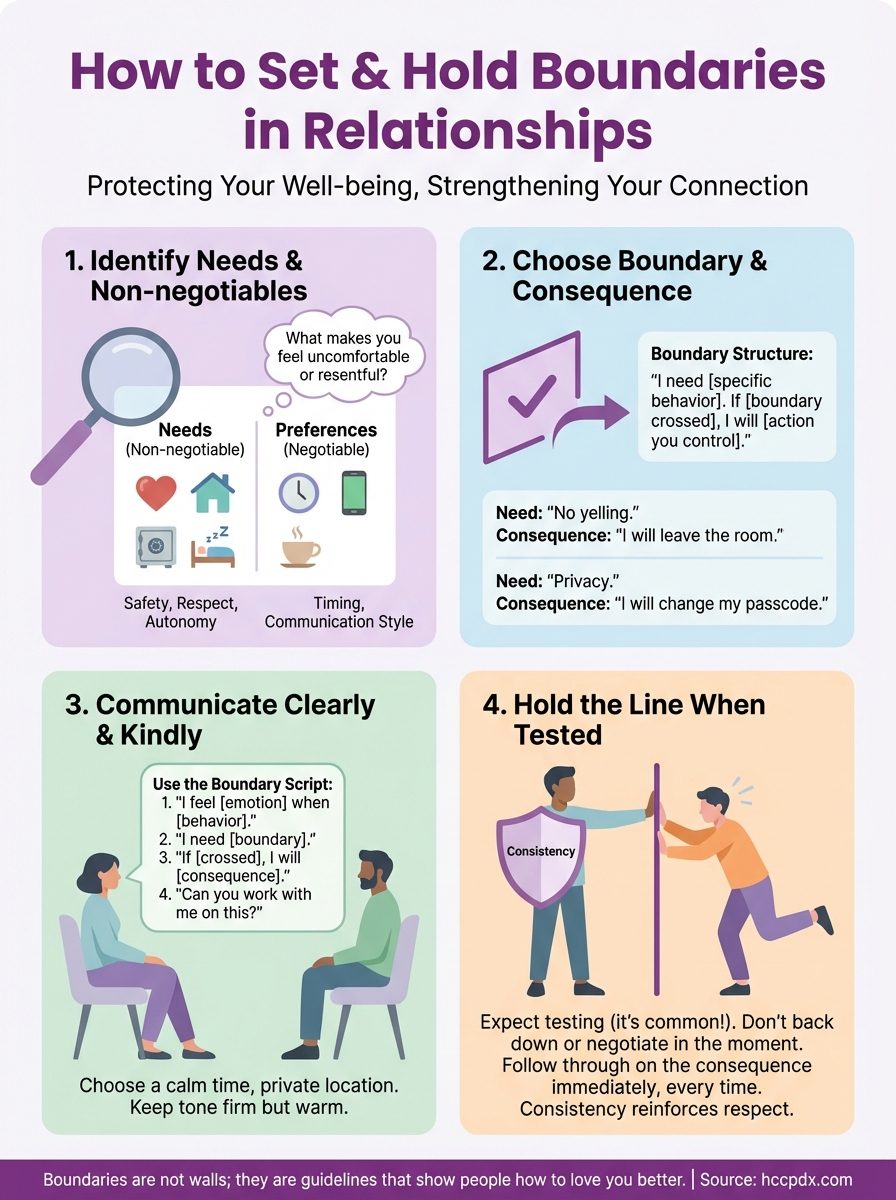
Step 1. Identify your needs and non-negotiables
Before you can explain your boundaries to anyone else, you need to know what they are yourself. Most people struggle with boundary-setting because they skip this crucial first step. You can’t communicate a limit you haven’t defined. Start by examining moments when you feel uncomfortable, resentful, or drained in your relationship. These emotional signals point directly to where boundaries are missing or being crossed.
Start with specific situations
Write down three recent situations where you felt frustrated or taken advantage of in your relationship. Don’t censor yourself or worry about sounding reasonable yet. You might list things like “My partner checks my phone without asking,” “I feel pressured to skip my gym time to hang out,” or “My partner criticizes my family during dinners.” The goal here is raw honesty about what bothers you, not polished statements ready for conversation.
For each situation, ask yourself: What specifically made me uncomfortable? What would I have preferred to happen instead? What outcome would leave me feeling respected? These questions help you move from vague discomfort to concrete needs. Understanding how to set boundaries in a relationship requires this self-awareness first.
Sort needs from wants
Not every preference deserves to be a boundary. You might prefer your partner text you back within ten minutes, but that’s not realistic or fair. A need, however, is something that directly affects your wellbeing or safety. Use this test: If this limit isn’t respected, will I feel unsafe, disrespected, or unable to function in this relationship?
Boundaries protect your core values and wellbeing. Preferences are negotiable. Needs are not.
Create two lists labeled “needs” and “preferences.” Needs might include “I need private conversations with friends without my partner listening in” or “I need to sleep in separate beds when I’m sick.” Preferences could be “I prefer we text during lunch breaks” or “I prefer we split chores equally.” This sorting process clarifies what you’ll negotiate on and what you’ll hold firm. Your needs become the foundation for the boundaries you’ll actually set.
Step 2. Choose the right boundary and consequence
Once you know what you need, you choose how to protect it. Not all boundaries require the same approach. A boundary without a consequence is just a request your partner can ignore. The consequence is what happens when someone crosses your stated limit, and you must be willing to enforce it every single time. Otherwise, you’re training your partner that your boundaries don’t actually matter.
Match the boundary type to the violation
Different situations call for different boundary structures. For minor ongoing issues like your partner interrupting you during work calls, a simple reminder boundary works: “I need you to knock before entering my office during work hours.” For repeated violations, you need a stronger boundary with clear stakes: “If you continue interrupting my calls, I’ll start working from the coffee shop instead.”
Serious violations like disrespect, invasion of privacy, or breaking your trust require immediate and firm consequences. When learning how to set boundaries in a relationship, many people make boundaries too weak at first. They say “I’d prefer if you didn’t yell at me” instead of “I will not accept being yelled at. If you raise your voice, I will leave the room until you’re ready to speak calmly.” The second version includes both the boundary and the action you’ll take.
Define consequences you’ll actually follow through on
Your consequence must be something you control and will definitely enforce. You can’t say “If you do this again, you have to apologize” because you can’t force an apology. You can say “If you do this again, I will spend the evening at my friend’s house.” Choose consequences that protect your wellbeing, not punishments designed to make your partner suffer.
A boundary you won’t enforce teaches your partner to ignore all your boundaries.
Use this template for building enforceable boundaries:
Boundary structure:
- “I need [specific behavior or change].”
- “If [boundary is crossed], I will [specific action you control].”
Examples:
- “I need you to stop commenting on my weight. If you mention it again, I’ll end the conversation and leave the room.”
- “I need my phone to remain private. If you go through it without asking, I will change my passcode and reconsider whether I can trust you.”
- “I need us to split household tasks fairly. If you don’t do your share this week, I won’t cook dinner for both of us next week.”
Notice each consequence is something you personally do, not something you force your partner to do. This keeps your power in your own hands.
Step 3. Communicate the boundary clearly and kindly
Having a boundary in your head means nothing until you speak it out loud. Your partner cannot read your mind, and expecting them to guess your limits sets both of you up for failure. When you understand how to set boundaries in a relationship, you know that clear communication prevents most boundary violations before they happen. The goal is not to attack or criticize your partner. You’re sharing information they need to treat you well.
Pick the right time and place
Never set a boundary in the middle of a heated argument or when either of you is tired, drunk, or distracted. Choose a calm moment when you both have time to talk without interruptions. Sit down together and make eye contact. Starting the conversation with “I need to talk about something important” signals that this matters and deserves full attention.
Location affects reception. Private conversations at home work better than public settings where your partner might feel ambushed or embarrassed. Avoid bringing up boundaries when you’re rushing out the door, during meals with others present, or right before bed when emotions run high.
The environment you choose for boundary conversations either invites cooperation or triggers defensiveness.
Use the boundary script
Structure your boundary statement using this proven template that keeps the focus on your needs rather than your partner’s faults:

Boundary communication template:
- “I feel [emotion] when [specific behavior happens].”
- “I need [specific boundary].”
- “If [boundary is crossed], I will [consequence].”
- “Can you work with me on this?”
Real examples:
- “I feel disrespected when you make jokes about my job in front of friends. I need you to stop commenting on my career publicly. If it happens again, I’ll leave the gathering early. Can you work with me on this?”
- “I feel overwhelmed when you text me constantly during my workday. I need you to limit texts to emergencies between 9 and 5. If the texts continue, I’ll turn off notifications and check messages at lunch only. Can you work with me on this?”
Keep your tone firm but warm. You’re not asking permission for your boundary, but you are inviting your partner to respect it willingly. If they react defensively, stay calm and repeat your boundary using the same language. Consistency in your wording reinforces that this is non-negotiable.
Step 4. Hold the line when it gets tested
Your partner will test your boundary, often within the first week. This isn’t necessarily malicious. People test boundaries to see if you mean what you said or if you’ll cave under pressure. The first time you enforce your consequence determines whether your boundary survives. If you back down, you’ve taught your partner that your limits are negotiable. Understanding how to set boundaries in a relationship means accepting that the follow-through is harder than the initial conversation.
Recognize the common testing tactics
Partners test boundaries in predictable ways. They might act hurt or surprised, claiming they “forgot” your limit. Some turn to guilt trips: “I can’t believe you’d actually leave over something so small.” Others promise to change while continuing the behavior. Watch for minimizing language like “You’re overreacting” or “It’s not that big of a deal.” Each tactic aims to make you doubt yourself and abandon your boundary.
When your partner tests, stay calm and restate your boundary using the exact same words from your original conversation. Repetition signals that you won’t negotiate. If they continue, implement your consequence immediately without anger or lengthy explanations. Your actions must match your words every single time.
Boundaries without enforcement become suggestions your partner can safely ignore.
Follow this enforcement checklist
Use these steps when your boundary gets crossed:
- Name the violation calmly: “You just checked my phone without asking, which crosses the boundary we discussed.”
- Restate the consequence: “I said I would change my passcode if this happened again.”
- Implement immediately: Change the passcode right then, or leave the room, or take whatever action you promised.
- Don’t negotiate in the moment: “We can discuss this tomorrow when we’re both calm.”
- Stay consistent for 30 days: Research shows new relationship patterns need consistent reinforcement for at least a month.
Your partner’s reaction tells you everything you need to know about whether they respect you. A partner who cares will adjust their behavior after one or two enforcements. Someone who continues testing your limits indefinitely is showing you they value their comfort over your wellbeing.
Scripts and examples for common scenarios
Knowing how to set boundaries in a relationship becomes easier when you have tested language to draw from. The following scripts address situations couples face regularly. Adapt the wording to fit your voice, but keep the three-part structure: state your feeling, name your boundary, and define the consequence.
When your partner dismisses your feelings
Emotional invalidation damages relationships faster than most conflicts. If your partner regularly minimizes your concerns or tells you you’re “too sensitive,” use this approach to protect your emotional wellbeing.
Your feelings don’t need your partner’s approval to be valid and worthy of respect.
Script example:
- “I feel hurt when you tell me I’m overreacting to things that matter to me. I need you to listen without judging my emotional responses. If you dismiss my feelings again, I will stop sharing them with you and talk to my therapist instead. Can you work with me on this?”
When personal time gets interrupted
Partners who constantly interrupt your solo activities show they don’t value your independence. This script addresses the common struggle of maintaining individual identity within a relationship.
Script example:
- “I feel frustrated when you call me multiple times during my gym hour asking when I’ll be home. I need that hour to be uninterrupted unless there’s an emergency. If the calls continue, I’ll leave my phone in the car during workouts. Can you work with me on this?”
When financial decisions affect both of you
Money conflicts destroy relationships when spending habits cross agreed limits. Clear financial boundaries prevent resentment from building around purchases, debt, or savings.
Script example:
- “I feel anxious when you make purchases over $200 without discussing them with me first. I need us to agree on major spending before it happens. If you make another large purchase without checking in, I’ll open a separate account for my paycheck until we can rebuild trust. Can you work with me on this?”
A simple way forward
Learning how to set boundaries in a relationship takes practice, not perfection. You won’t master it after one conversation, and you’ll make mistakes along the way. What matters is that you start. Pick one boundary from your list and communicate it this week. Use the scripts provided, enforce your consequence when tested, and notice how your relationship shifts when you stop abandoning yourself to keep the peace.
Your boundaries protect the relationship by protecting you. When you show up as a whole person with clear limits, you give your partner the chance to love the real you, not the version that says yes to everything. Some partners will rise to meet your needs. Others will reveal they never intended to respect them.
If you’re struggling to maintain boundaries or your partner resists every limit you set, professional support can help. Healing Connections Counseling works with individuals and couples in Portland who want to build relationships grounded in mutual respect and authentic connection.